
30 questions parents often ask us
1. What is open-ended play?
Open-ended play is playing without a fixed goal. No rules, no winning, no button that makes a sound when you do it right. The child decides what to do, for how long, and when it is finished. We used to just call this playing. These days we need a name for it, because so much toy now tells you what to do with it.
2. How do you start with open-ended play?
You don't have to start. It isn't a project. Take a look in the toy cupboard and remove everything that does just one thing. What's left is usually open-ended. Add something very simple if you like: a few wooden blocks, a basket of loose parts, a cloth. And then you step back. That's where the most important part of the whole story lies.
Read all 30 questions ↓
3. Does open-ended play belong to a particular philosophy?
Not to one. But it is related to Montessori, Waldorf and Reggio Emilia. Maria Montessori already said that a child learns more from choosing for itself than from being directed. Rudolf Steiner saw free play as the basis of everything that comes later. In Reggio Emilia they have worked with loose materials in ateliers since 1945. Open-ended play has no founder. It is more an attitude that returns in all of these approaches.
4. Why is open-ended play so popular?
Because parents see that a lot of toys are played out quickly. Screens give plenty of stimulation but little depth. Parents are looking for something that lasts longer and leaves more room for what their child can do itself. As knowledge becomes so easily available in the world, parents sense that the future will ask for very different qualities, qualities tied to who we really are. People sense that it is needed.
5. What is the difference between open-ended play and Montessori?
Open-ended play gives complete freedom. No goal, no right or wrong. Montessori works with materials that have one clear learning goal and correct themselves. Both encourage independent learning, but along a different path. A lot of toys fall into both categories at once. Our Wobbel too.
6. What is the difference between open-ended and closed-ended toys?
A puzzle has one solution. A game with rules has a winner. That is closed-ended. Open-ended toys have no fixed outcome. A wooden block can become a car, or a phone, or a mountain, or nothing. Both are valuable. Open-ended toys simply stay interesting longer because the child can keep thinking up something new.
7. Can anyone just start with open-ended play?
Yes. No course needed, no membership, no special purchase. The most important thing is that you don't intervene when your child uses a block as a phone. For children this is natural. For most parents it is something to get used to. That is honestly the hardest part.
8. Is there a parenting vision behind open-ended play?
Yes: trust in your child. That is the core for me. The starting point is that a child is creative by nature and can come up with its own solutions. As a parent you make the environment and then you step back. That connects to what psychologists call “holding space”. Giving room without steering.
9. Why is open-ended play important?
Because children who play this way develop skills that are hard to catch up on later. Creativity. Perseverance. The ability to deal with boredom and then make something out of it. Research shows that children play three times longer with open-ended materials than with toys that do one thing.
10. What characteristics does open-ended toy have?
Five things. No fixed play goal. A simple shape. Natural materials such as wood, wool or cotton. Suitable for several ages. And room for imagination. The simpler the shape, the richer the play. That sounds strange, but it really is true. Often it is simply beautiful too. And what is beautiful, we take good care of. You don't have to learn that, it is already in people.
Which toys fit
11. Which open-ended toy suits a baby?
For a baby it is all about the senses. Feeling, looking, putting things in the mouth. Soft cloths, wooden teething rings, simple stacking towers. Our Wobbel Starter is suitable from about 1 year. First as a rocking object, later as a climbing playground. It grows along until 2.5 years and then it fits under the Wobbel Original.
12. Which open-ended toy suits a toddler?
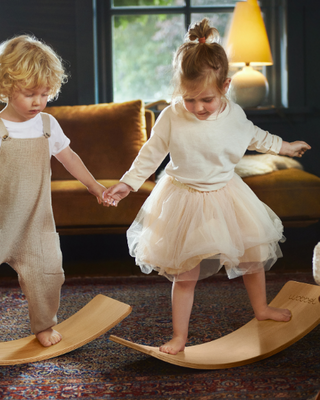
Toddlers begin with building, sorting and first role play. Wooden blocks, Grapat figures without faces, a Wobbel to rock on or build a tunnel with, coloured rings to sort by size. Material that looks simple and can become a hundred things.
13. Which open-ended toy suits a preschooler?
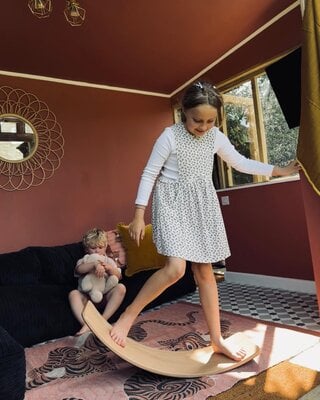
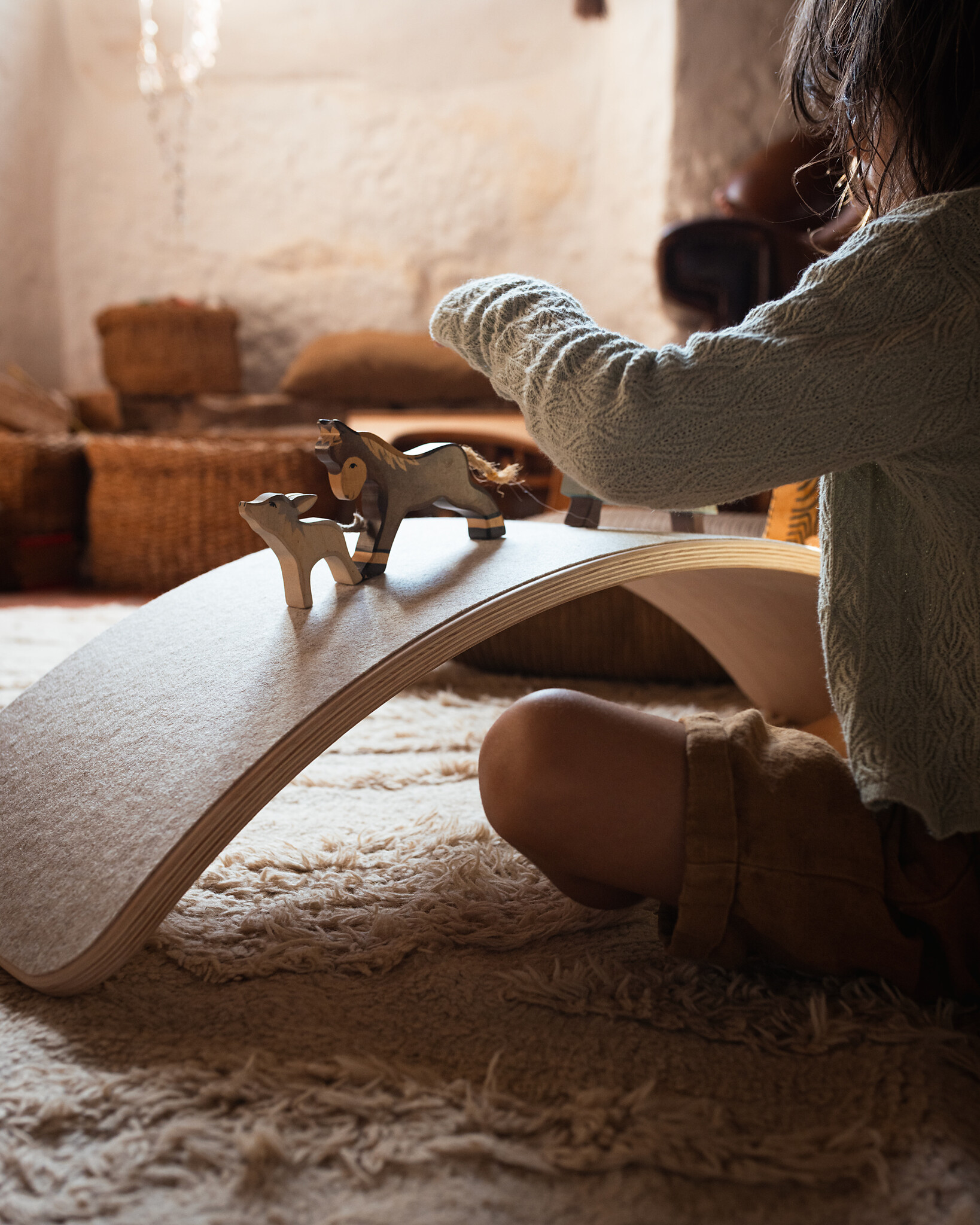
With preschoolers, imagination comes to life. Kapla planks, Grimm's rainbows, magnetic tiles such as Connetix, Grapat loose parts, wooden animals, play cloths. A Wobbel becomes a boat, a stage, a bridge or a slide for soft toys. This is, as far as I'm concerned, the most fun age to watch.
14. Which open-ended toy grows best along with my child?
Three kinds of material last the longest. Wooden blocks such as Kapla and Grimm's. Loose parts such as Grapat. And movement toys with an open shape, such as our Wobbel. The Wobbel Original is usable from 2 to 12 years. The XL holds up to 200 kilos and can therefore literally last a lifetime.
15. Which open-ended toy encourages movement?
Most open-ended toy classics are about building or imagination. For movement the choice is smaller. A Wobbel balance board, a Pikler triangle for climbing, or an indoor climbing frame. At Wobbel we are glad that we are not only open-ended, but also invite movement and rest. That makes the Wobbel a category all of its own.
16. What is the best investment in open-ended toys?
Good open-ended toys can't be pinned down to ten years or any other number. They last for years. The moment you hold one, you feel it. They are also so beautifully made that even after your children have outgrown them, they still stand beautifully in your home. Carrying memories. That is the finest kind of toy. Lived-in, full of energy. One good object is worth more than five cheap ones, financially too.
17. Which open-ended toy do you choose for two or more children?
Something that can be played both together and apart. Building sets, loose parts and Wobbel boards work in both forms. One child builds alone, two children make up a game together. A Wobbel can be a step stool for one and a slide for the other's soft toys at the same time.
18. What do you look for when buying open-ended toys?
A few things we always check ourselves. Natural materials. FSC certification for wood. CE marking. Rounded edges without splinters. Child-friendly varnishes. And where the product is made. Cheap toys almost always save on one of these points. That is why we make our Wobbels the way we do.
19. Is wooden open-ended toy always better than plastic?
Not automatically, but usually. Wood has qualities that plastic does not. Warmth. Weight. Sound. Smell. Children respond intuitively to natural materials. Indoors I always prefer wood. Personally I also just find it nicer in the home.
20. Which brands are the best in open-ended toys?
In Europe these are the names you come across most. Grimm's for wooden rainbows and blocks. Grapat for loose parts and figures. Kapla for stacking planks. Connetix for magnetic tiles. Ostheimer for wooden animals. And us for open-ended movement play. What these brands have in common, and why they are so successful in Europe, is the focus on sustainability, natural materials and aesthetics. The toys are designed so they don't look out of place in a modern living room, grow along with your child and activate creativity. Instead of a child passively watching toys make sounds with batteries. Which brand suits you depends on your child and the type of play it loves. Feel free to combine.
Open-ended play in everyday life
21. Is open-ended play expensive?
Per item often yes. In total often not. A Wobbel costs the same as three plastic toys that are played out within a year. Good open-ended toys keep their value. Toys from solid brands sell for a lot second-hand, so the cost per hour of play is actually very low. They are also meant to be passed on again and again, child to child within the family, and later to the grandchildren.
22. How much open-ended toy do you need?
Less than you think. A cupboard full of toys paralyses. A basic set is enough. One building material, one set of loose parts, one movement object such as a Wobbel, and possibly something sensory like clay or sand. With that a child plays its way through all developmental phases for years. We have grown into this less-is-more thinking ourselves too.
23. Where do you store open-ended toys?
Don't hide them. Leave them visible at child height. Open-ended toys are only used when they invite. A basket in the living room or a low open shelf works better than a closed toy chest. What the child sees gets used. What disappears into a cupboard is forgotten.
24. Which schools work with open-ended play?
Montessori and Waldorf schools work almost entirely from this idea. Reggio Emilia schools put loose parts and open materials at the centre. More and more mainstream primary schools integrate elements of it in the kindergarten class, often in the discovery corner.
25. What does open-ended play give my child?
Four things that are scientifically supported. Creativity, because the child has to come up with its own solutions. Perseverance, because there is no next level. Self-confidence, because there is no right or wrong. And concentration, because children without a fixed goal keep playing with materials longer. These are skills that are hard to catch up on later in life.
26. What does open-ended play ask of me as a parent?
Mostly restraint. Not intervening when your child does it differently than you would. Not asking what your child is making. Not complimenting straight away. The child needs time to sink into the play. The first minutes often look aimless. Open-ended play asks parents for the courage not to help. For me personally that has always been the hardest. Of course you always keep an eye on safety.
27. Can I combine open-ended play with ordinary toys?
Yes, and that is usually best. A balanced mix works strongest. Closed-ended toys for goal-directed work, open-ended materials for creativity and imagination. The one does not exclude the other. A lot of toys become open-ended by themselves once a child starts playing with them outside the rules.
28. How much time per day do you need for open-ended play?
No fixed number. But long blocks. At least 30 to 45 minutes without interruption. Shorter than that and a child hardly reaches the deeper play. One or two blocks a day are often enough. And a child that is bored is not a problem you have to solve. Being bored is part of it.
29. When can you start with open-ended play?
From birth. A baby explores with the senses. A young toddler stacks and throws. A toddler sorts and builds. A preschooler invents stories. The same material is used differently at every age. That is exactly the magic of open-ended.
30. Is open-ended toy better than other toys?
Not better, but different. A balanced mix works best. Open-ended toys train creativity and perseverance. Closed-ended toys train following rules and goal-directed work. Both valuable. The difference is that open-ended toys last longer because they grow along with your child. And sometimes just with you too.
Do you have a question that isn't here? Send me a message. I answer personally.
Hannelore
Why parents choose the Wobbel
The child is enough. Play is enough. We only need to make the space.
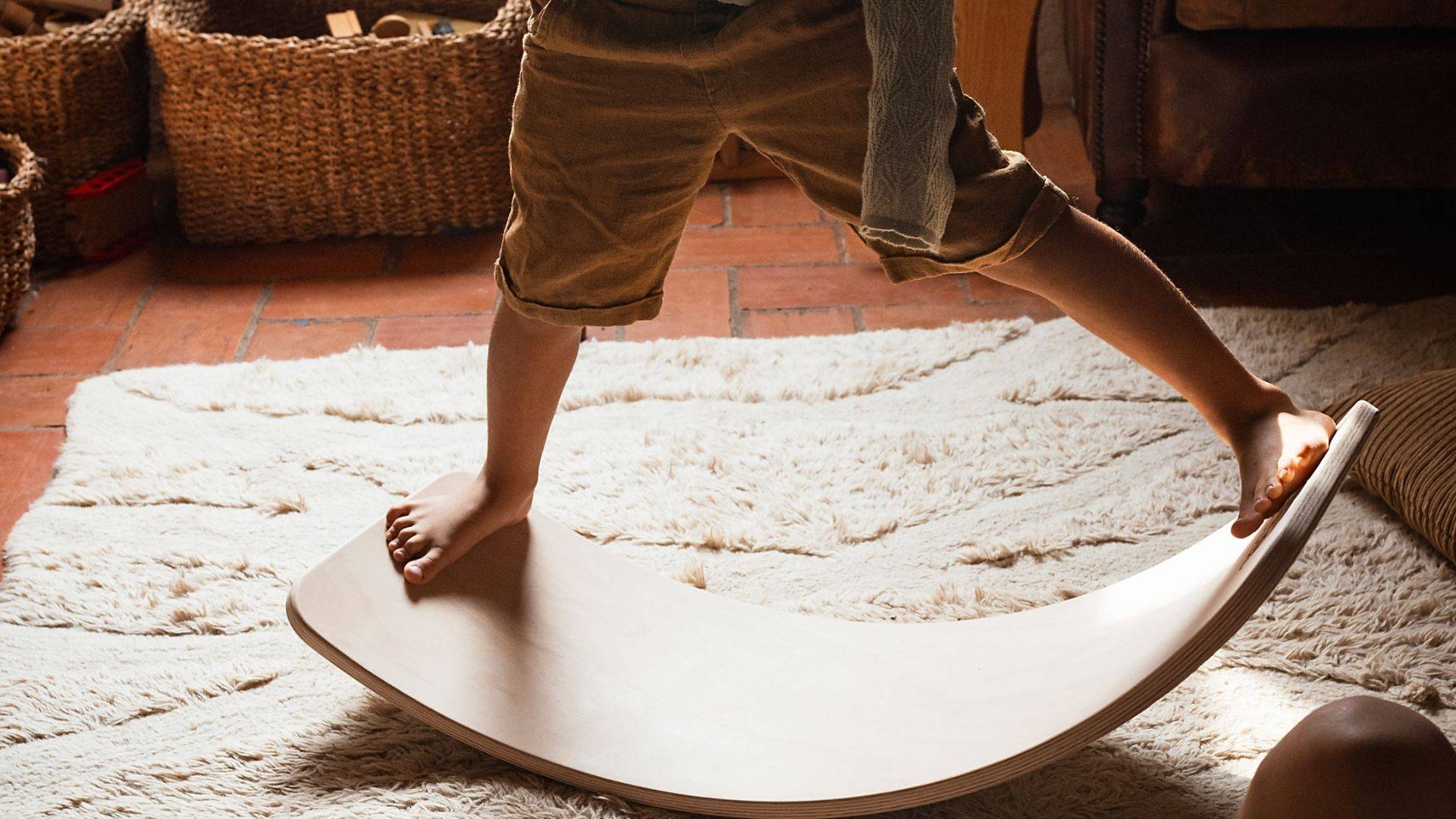
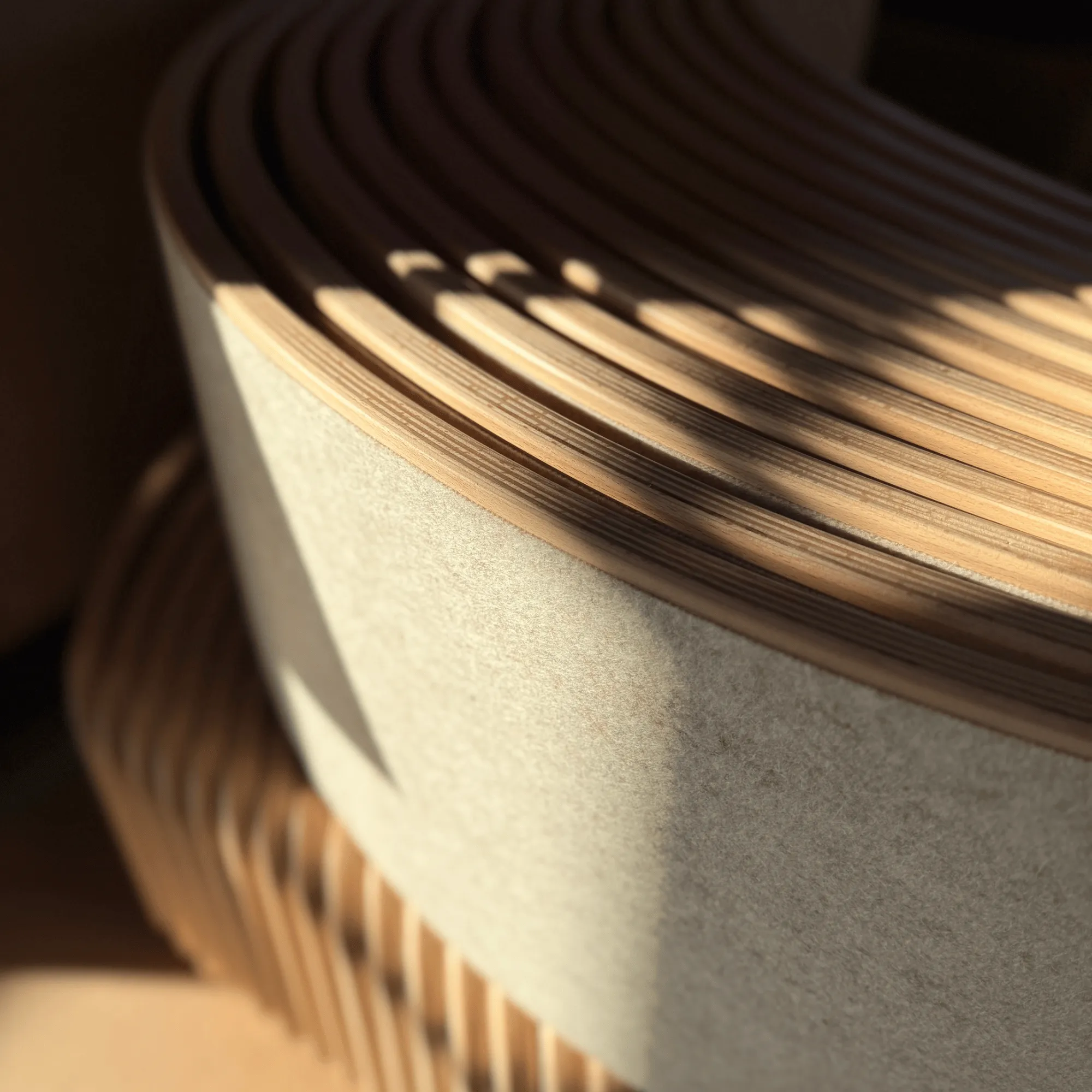
The Wobbel is the original wooden wobble board, designed in the Netherlands in 2015. A simple curved piece of FSC® certified beech wood that became something much bigger. Today over 100,000 children across Europe play with one.
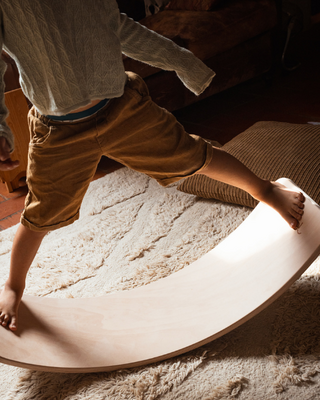
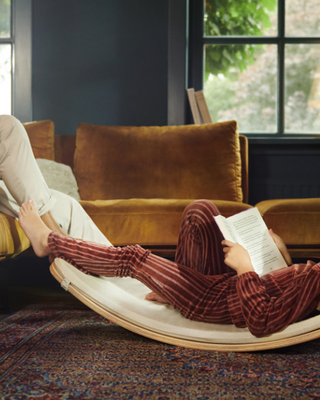
A wooden balance board for kids and toddlers that grows with your child, from the first wobble at one year old to the standing desk of a parent. Babies, teenagers and adults all use the same Wobbel, just differently. Today a bridge. Tomorrow a slide. Next week a hut. Whatever your child sees in it, is what it becomes.
Choosing a Wobbel is choosing to trust your child. To say: I trust that everything you need to learn and play is already inside of you. I will make the space. I will offer the invitation.
This is what open-ended play looks like in physical form. A balance board that asks for nothing and offers everything. No instructions, no screens, no batteries. Just movement, imagination and the child itself. The same idea that made Montessori and Waldorf classrooms so quietly powerful, now in one wooden curve.
The original since 2015. Awarded the French Milk Award and Japan's Good Toy of the Year. Handmade in Europe from FSC® certified beech wood. CE-approved, safe to load up to 200 kilograms, built to last many adventures.
There is only one Wobbel.
When there was none to be found, we made one ourselves. For our own children. And we are happy to make one for your children too. With just as much love and care.
We'd love to tell you more →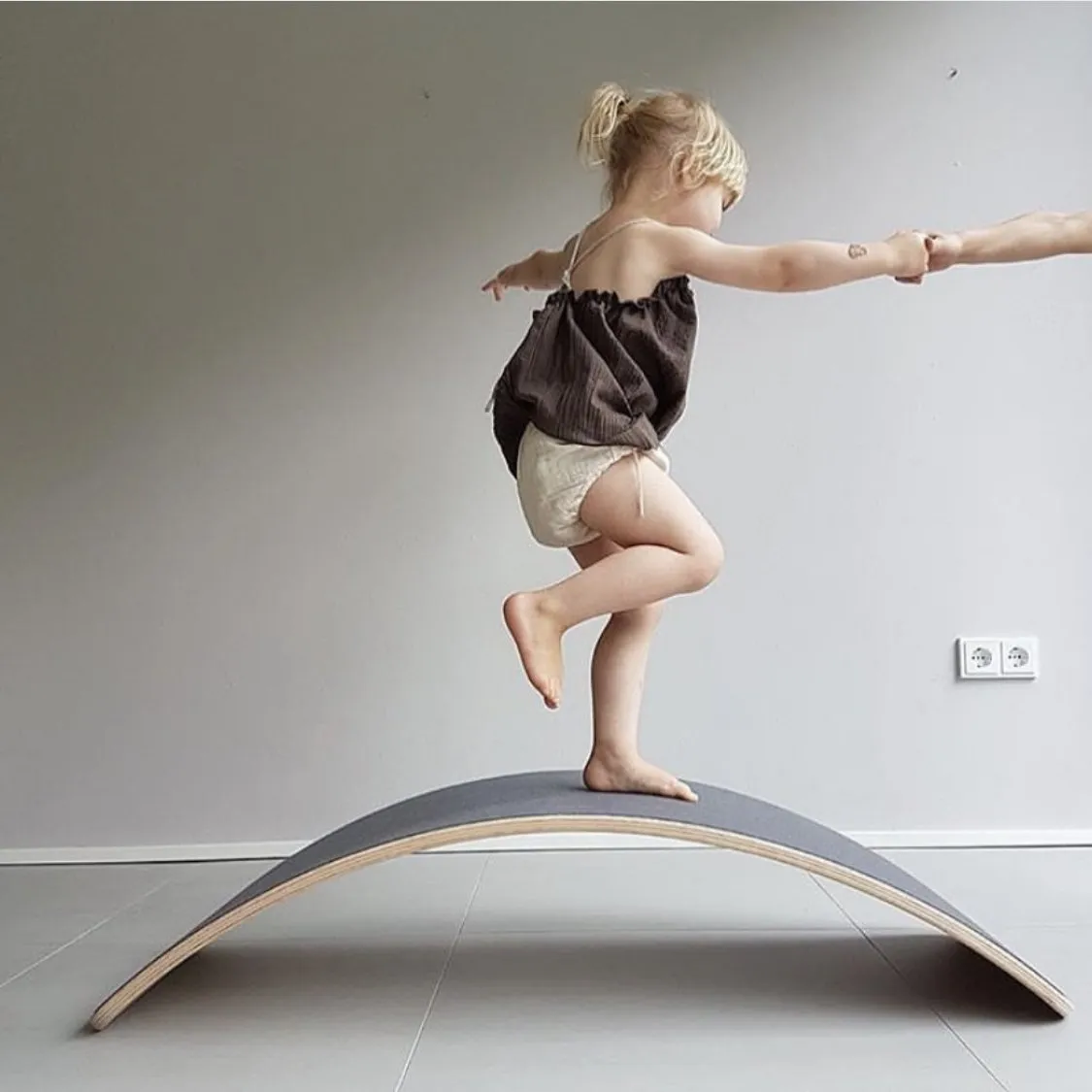
See what happens when you say nothing.
Wobbel is a recognized voice of open-ended play in Europe. No instructions, no screens. Just movement and the child itself.
Read all about open-ended play →